A Comparative Analysis Between Jodi’s Untitled Game, My Ambitions, and Related Works
A reflection from my time in "History of Art and Technology" seminar

Author Note: To play Untitled Game, you can download the files from here and then use an in-browser Mac OS 9.0 emulator from InfiniteMac.
For a brief introduction to the motivation behind my work, I pull a passage from my portfolio statement:
I seek to highlight my love for computing technology through the hardware and software-based projects I have composed. Many of the pieces involve or are otherwise related to retro computing technology. With retro devices, there is a greater reliance on physicality and thus emphasis on the technology as the bridge between people. Explicitly, the motivation behind my work is to convey this intimate and communal nature of older technology.
For the piece I plan to create, I hope to craft a piece of Vaporware / Shareware based either on a modification of an existing video game, or within a legacy game design engine. Vaporware is “a computer-related product that has been widely advertised but has not and may never become available” (Merriam-Webster). Shareware “is simply software that anyone with a modem can download for free from storage archives” (Blink). I plan to work with the legacy game engine known as “Source”, created by Valve for use in games like Team Fortress 2, Counter Strike: Global Offensive, Half-Life 2, and Portal. While I have considerable experience in computer programming, I do not have much experience with developing within video game engines; this project would be a great opportunity for me to do so.
Throughout reading Digital Design: A History by Stephen J. Eskilson, few pieces stood out to me as much as those by “net.art” pioneers “Jodi.org” aka “Jodi” (art collective). Specifically, their piece Untitled Game called to me as it was instantly recognizable as a precursor to so many works that I have come to love. Pieces that come to mind are: The Beginner's Guide, The NieR: Automata Church, and MyHouse.wad. Each of these “games” rely on the modification of an existing game or game engine to create the world in which their story occupies. In the case of Untitled Game, the currently accessible version presents itself as a file directory listing on the web, notably with file names including "arena", "E1M1AP", and "slipgate". Each of these names provides a hint to the fact that Untitled Game is actually a modification to the game Quake by Id Software.
Due to being a modification of a preexisting video game, audience interaction is a cornerstone within the realm of Untitled Game. Art, ultimately, is a form of communication, and traditionally the dialogue between the work of art and the audience is an internal, passive one. Interactive works, attempt to push this boundary by requiring more of the audience, i.e. making them an active member in the dialogue. Video games and computer programs are prime examples of this; the interactivity within the game itself relies on the user’s knowledge of how to navigate the virtual world using the computer peripherals before them. Through Untitled Game, Jodi exploit this to create a piece that not only engages the user but requires of them a degree of effort.
In the case of The Beginner’s Guide, a game created in the Valve “Source” engine, the premise of the game as described by Wreden is such that:
Let's say you sit down at a stranger's computer. You start opening up files and looking through stuff and eventually you come to a folder that just says, “my work”. So, you open it and you click on a random file and it's a video game that looks like this. If you had to guess, what would you say you know about this person right now?
In the case of The NieR: Automata Church, this piece was shared online as a supposed discovery of a “secret level” of sorts online before being revealed as an unofficial mod for the titular NieR: Automata.
Hello here is the video for the clip i recorded on my ps4 that i put on my usb of the door for the church hallway i uploaded for the discord server. I got a space error because i recorded too long i think.
by u/sadfutago in nier
Finally, in the case of MyHouse.wad, a modification for the Id Software game Doom II, the game was shared online as a piece of “found media” similar to that of the manuscript within Danielewski’s House of Leaves.
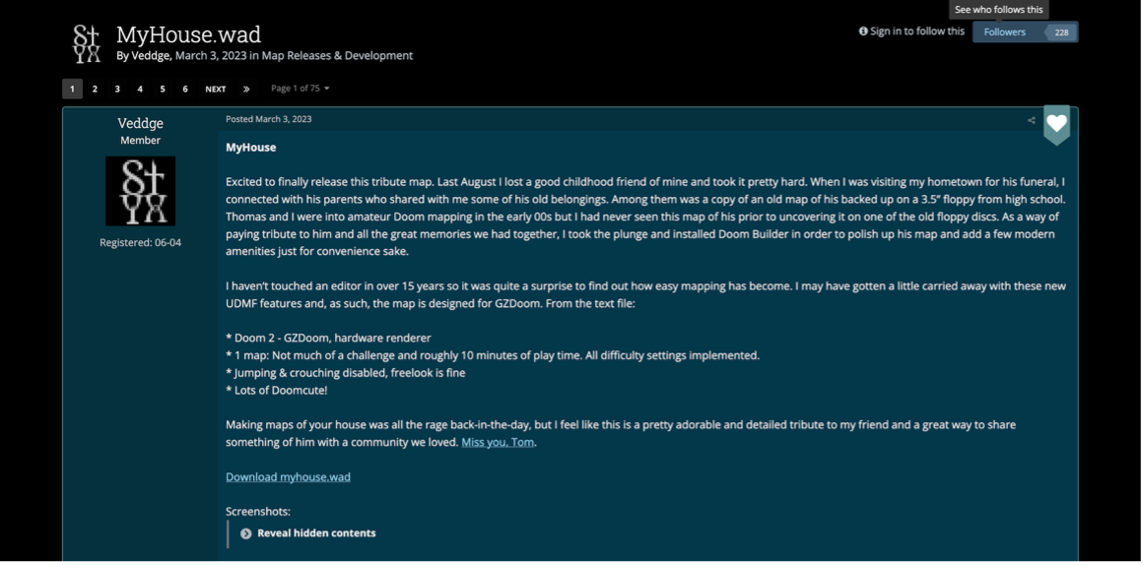
For each of these pieces, the method of creation and distribution is integral to the overall narrative. The goal with my work would be to create a similar degree of context and world building surrounding the creation, distribution, and discovery of the piece.
Due to performance and size requirements, a distinguishing factor between video game software from most other modern software is its method of distribution. There are many pieces of game software that are shared as single “files” or “executables”. In high school, my friends and I employed a shareware method of propagating a modded version of Halo: Combat Evolved across various computer labs in our school district. As the program now rests on each computer’s hard drive, these copies of the program will remain on the computers and thus can be further copied until actively removed from the machine. Future users of the computer (most likely for educational purposes) may stumble across this now archeological piece of software. This unearthing of a seemingly innocuous file within the computer is integral to the narrative of both Untitled Game and The Beginner’s Guide as shown above.
The NieR: Automata Church and MyHouse.wad rely on a slightly different method of distribution. Both pieces were initially shared on an online forum (“forum” here I generalize to include Reddit, a social media platform. I want to be sure to note that many aspects of social media platforms disregard the communal nature of forums see: “Community Second: Death of the Internet Forum”) dedicated to the game that they each respectively modify. Both pieces as well rely on the forum as platform and the post itself as a tool to craft context around the mystery of its “discovery”. The use of a forum begets discussion. As participants on the forum, the user has no reason to assume malintent from the creator, especially if all aspects of the post seem to be made in earnest. Thus, if fabricated convincingly, as in the case of the The NieR: Automata Church and MyHouse.wad, a degree of allure and mystique is added to the piece. This intentional misuse of the forum as a tool helps the piece to transcend the preconceived boundaries of the computer, creating a false reality in which the work exists.
When reflecting on the historical context around these pieces, I am immediately drawn to epistolary (in the form of letters) works, found footage films, and alternate reality games (ARGs) at large. Lately, I have also been exploring the world of ergodic literature, namely works of cybertext (both terms coined by Espen Araseth). As described by Aarseth in Cybertext: Perspectives on Ergodic Literature:
… ergodic, using a term appropriated from physics that derives from the Greek words ergon and hodos, meaning “work” and “path.” In ergodic literature, nontrivial effort is required to allow the reader to traverse the text.
… cybertext focuses on the mechanical organization of the text, by positing the intricacies of the medium as an integral part of the literary exchange. … it also centers attention on the consumer, or user, of the text …
I think a distinction should be made between pieces that are designed with this narrative complex in mind and those that have become ergodic retrospectively. To describe the former, consider muti-user dungeons (MUDs). These require real time navigation from the player and often even collaboration with others. To describe the later, consider any piece of MS-DOS computer software. To access the software in current day, it requires that: 1. You have a physical copy of the software or otherwise a backup, and 2. You have the hardware or software in place to run said program. Consider these statements regarding Jodi’s Untitled Game. The piece itself was created with the requirement that a user must interact with the system, be that “playing” the game itself, navigating the menus within the game, or the file system of the computer itself. And accessing this piece today required me to set-up and install a Mac OS 9 emulator, which was only relatively simple to do because I have a Mac and other engineers have already done most of the work in supporting this legacy platform.
I believe that aspects of cybertexts can be exploited as tools with which to use as a basis for world building. In creating my piece, I want to be intentional about how its distribution affects its received perception. Thus, I envision utilizing internet forums to encapsulate my work. Regarding the creation of the piece, I plan to interact with or otherwise utilize the user’s understanding of how the computer operates. A possible option is to do so through interacting with the underlying file system or operating system in an atypical fashion. Finally, I plan to incorporate an aspect of discovery into my piece to enhance the overall aura. This either through the illusion that I have “made” a discovery or by enabling the users to make this discovery for themselves. Each of these aspects—creation, distribution, and discovery—I find reflected in Jodi’s Untitled Game: a collaborative, subversive, and cybertextual work.